

Catholics online. How we’ve become just like the scene at the Last Supper.
In this blog post, we’ll explore two contrasting cultures presented in the Gospel, the love of winning arguments (philonikia) and the pursuit of hospitality (philoxenia).
In this blog post, we’ll explore two contrasting cultures presented in the Gospel, the love of winning arguments (philonikia) and the pursuit of hospitality (philoxenia).
Imagine you’re one of the twelve apostles, gathered with Jesus for that solemn final dinner before his crucifixion. What urgent questions would you whisper to him? And just as importantly, what would your conversations with those around you reveal about just how much you actually understood from his teachings.
It’s a stark scene in Luke’s Gospel, where the author uses the word “philonikia” (fee-low-knee-KEE-uh), the Greek word for a love of winning arguments to describe the conversation taking place amongst the apostles.
Right in front of Jesus, they were arguing about which one of the apostles was the greatest! Let’s imagine this was done in different words though. Perhaps the apostles were chattering at dinner about who had served more, who had listened to more of Jesus’ sermons, or even who was the most likely to convert mass followers. Do we see this anywhere today in Catholic circles on TikTok, other social media, or even arguing with Protestant friends at work? I’m sure we could agree that just about all of the apostles shared a common loyalty and devotion for their teacher. However, even amidst great piety, there was a powerful ambition simmering beneath the surface. Even in a moment as sacred as the Last Supper.
At Theology for the Unwanted, my posts try to stress the new theological landscape: a culture that is increasingly online and isolated rather than face-to-face. You don’t have to spend too much time online before the spirit of philonikia takes over your timeline. Before judging it, we have to take a moment to see the great devotion present in the profiles of those who truly want to see everyone united in a common Christian home.
However, being right does not build virtue.
Theologian and Czech Catholic priest, Fr. Tomas Halik, offers an honest critique of Catholic apologetics and those whom we try to convince. In his book, The Afternoon of Christianity: The Courage to Change, he outlines the many pendulum swings where the Church has gone from strict to lax, a source of ideas to a community organizer, and how we have put ourselves into ideological boxes. Most notably, how in the past few centuries we have seen ourselves as a form of combating liberalism or Protestantism. Every hero needs a villain, right?
In a world where the theological landscape is defined by strife, all virtues must be understood for their relational abilities. Or, more simply: how do we become more warm and pleasant while simultaneously inviting people into a relationship with Christ? It probably isn’t by drawing harsh redlines (e.g., only welcoming people who are fully compliant with Catholic rules to be full and active participating members in your parish).
More importantly, we have to get out from behind our screens and build a community that is in person. If we are alive and human, then we must recognize that God created us to be in relationship with others and that means being present in person.
On the other hand, the New Testament presents us with a remedy for the addicting love of strife: “philoxenia” (fi-lo-KSEE-nee-uh). The love of stranger. Sometimes its also translated to mean the love of hospitality. Growing up, our teachers in Catholic school always told us to be counter-cultural and this is exactly how Saint Paul defines it when he tells Christians to “contribute to the needs of the holy ones” (Romans 12:13).
Remember that Saint Paul did not live in a democracy. He lived in a society that was rigidly structured, where status and hierarchy were very important. But this is not the way of the Gospel. He was telling Christians to pursue hospitality, regardless of whether the person knocking at the door was a peasant or a government official. The very idea of gathering around for the Eucharist quite literally built communion.
Christ died for all; therefore, Jesus desired for each of us to be with the Father in heaven. So who are we to draw redlines and say who is in the club and who is to be excluded? Saint Paul describes this as a moral obligation, even when it draws us out of our comfort zones.
Recently, someone stopped by my home parish saying that he wanted to learn more about the Catholic faith. Initially, a well-meaning parishioner replied enthusiastically, “Great, what are your questions about Catholics.” I could see a somewhat overwhelmed look on the face of the man who maybe was looking for something a bit more casual. Perhaps because of the heightened tension between Protestants and Catholics in English-speaking countries, our best Catholics tend to be very well versed in explaining and defending the faith.
I asked if it was possible to take him on a very brief tour of the art and the relics of the saints in our sanctuary. That piqued his interest. On the way upstairs, he had an opportunity to tell me more about his own background and what made him interested in asking about our faith. It started a dialogue, and by the time we had finished the tour, he was visibly more relaxed about his decision to stop by the church.
We must remember that for those who lived during the time of Jesus, there were no textbooks to tell us how to reply to questions and objections about the Christian faith. Jesus Christ himself was an “encounter.” And so we too have to try to foster this type of encounter with those who stop by our parishes wondering what it is that Catholics actually believe. An argument may win the war, but it will not provide the type of encounter that the Eucharist is seeking to foster.
Our words online should reflect this, and even more so, our presence in the parish and in our communities.

Learning to speak the languages of the Holy Spirit
When we imagine the Pentecost scene from the Acts of the Apostles, it often feels magical, as if the Holy Spirit implanted a divine translation device. Yet, the true "languages" of the 21st century are found in the suffering of others—poverty, pain, and exhaustion—which, when truly seen, allow us to speak the Holy Spirit's languages of consolation and un
During the feast of Pentecost, we hear about the Apostles being gifted the ability to speak many languages. Not gibberish, but actual languages that people, who previously couldn't comprehend due to different nationalities, were suddenly able to grasp the deeper meaning of Christ.
When we imagine that scene from the Acts of the Apostles, there's a sort of magical quality to it, as if the Holy Spirit implanted a translation device into the minds of the Apostles. Few of us, if any, anticipate we'll ever speak in tongues in a way that makes everything around us suddenly make sense.
This still happens today, but we must set aside our expectations of something "magical" and instead listen for how the Holy Spirit is instructing us. The languages are not always spoken. Poverty, pain, and exhaustion are the languages of the 21st century. Suffering is the language of the crucifixion. And by getting close to these realities that we often turn a blind eye to, the Holy Spirit will gift us the ability to speak his languages: consolation and unity.
As mentioned on the podcast and elsewhere on this blog, in a world where isolation, loneliness, and communicating screen-to-screen define our new theological landscape, we must understand virtue and vice through a relational lens.
Virtues are those abilities that allow us to see the unique dignity, gifts, and talents of others, and to understand how our presence can help create harmony with them. On the other hand, vice focuses on the self. It takes the gifts of others and indulges the self without regard for their full dignity.
While on a visit to Rome, I had to literally step over a homeless person who was blocking the entrance to a beautiful Renaissance basilica where I wanted to pray. Thinking I was being righteous, I asked the parish priest, "What am I supposed to say to a homeless person?"
He said sternly to me, "Sit down." I thought I was being a delightful Christian by asking him my duty. The look on his face, however, made me realize my approach was totally wrong.
He didn’t answer my question. Instead, he challenged my entire framework and approach to being Catholic.
"You must understand that each one of these persons is made in the image and likeness of God. The Father desires to see them in heaven. Jesus died equally for them on the cross as he did for you. And Mary sees them as her beloved children."
After several more minutes of the lecture, he concluded, "Now say your act of contrition!"
It’s so funny. I thought I was speaking the language of Christ, but my approach clearly showed no indication that I recognized their dignity, despite my desire to know what to say to a homeless person.
That stern lesson has stuck with me for many years. To foster virtue, I have to get really close to the suffering of others.
Now, when I pass by a homeless person sprawled out on the hot sidewalk, I try to remind myself, "That is the language of the crucifixion." Only then am I open to the Holy Spirit’s wisdom, which allows me to speak consolation and unity with others.
Theology of the Mosaic
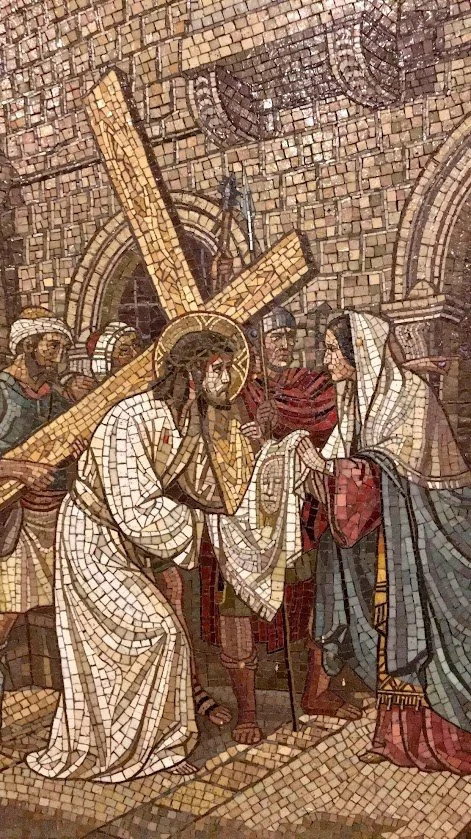
It’s time to go deeper in the way we foster virtue in our communities. Name any cardinal virtue (temperance, prudence, fortitude, justice) and almost everyone will describe these– still very important abilities– through the lens of discipline. As you may have noticed from the reflections page, I believe we can learn about virtue by studying mosaics.
The virtues reflect the idea that we’re all made in the likeness and image of God. Each of us are
like a singular tile in a beautiful mosaic. We become more who we were made to be through harmony with “the other” to reflect back this image of God. No one tile in a mosaic, regardless of how much gold is painted on it, makes a beautiful complex picture. Similarly we only become more ourselves through relationships and responsibility for others, without trying to possess or overshadow them.
But growing up, virtue was taught to me like a list of good and bad habits. No wonder it’s hard to convince people that a virtuous life is a happy life. If the virtue of chastity is reduced to a suppression of our desires it can create a breeding ground for abuse and power dynamics.
Sometimes we talk about integrating our desires in a healthy way, but the conversation typically falls back to a focus on self-mastery.
Unfortunately, we often obsess about vice. We obsess about ourselves.
I talked about Saint Bruno in the previous post, and fully believe that the self-denial he preached remains important to this day. But what is its context in the society where we live today? How does it help create the Christian encounters that are absent from society?
Instead, if we want to thrive in the modern world, we have to graduate away from what Charles Taylor calls the honor society (compliance, rank), and instead become the dignity society (discovering God through others, by regarding their differences as gifts in God’s image).
Virtues, less so about their moderation, should be about orienting our lives toward sacramental encounters. It’s about holiness (a process of becoming). And our success orienting ourselves toward becoming holy will have its ups and downs. That’s where we humbly ask God for forgiveness and help.
Saint Thomas Aquinas focused a lot on desires and whether they are “ordered” or “disordered.” Briefly summarized in modern English, it seems he was almost always making a distinction between “harmony” and “possessiveness.” So we can start with understanding our virtuous desires as a drive toward positivity and stability – not just of ourselves– for the greater good.
With virtue, the goal should become a co-creation. God gave us gifts and talents. He divinely created a unique identity for us, that through our Baptism, calls us to be a beacon of light in the world. The very existence of marriage in nature and in the Church is a de facto recognition that we are made for others. We become more ourselves through our relationships with others.
There’s a sort of completeness that cannot be obtained in life by solely being by yourself.
For example in marriage, the sacramental encounter is recognized by the freely given & total unity of two people, with all of their differences. The differences found in the bride and groom matter, as it gives life to their pursuit of virtue. And in their daily lives as a couple, regardless of whether the couple has sex or not, they are called to will the good for the other. The main difference between charity and chastity is the transformative desire to transmit love through the dignity of the physical human body. And, whether by giving birth or adoption, a couple can become witnesses to the fruitfulness of God’s abundant blessings on his family.
In many marriages, a time may arise when one partner experiences less interest in sexual intimacy. This does not diminish the sacramental nature of the marriage. Blessed by the Church, the success of the marriage ultimately rests on the couple’s ongoing commitment to encountering God’s divine love through each other.
Particularly after the grave sex scandals in the Church, fewer and fewer people believe the line that pornography contributes to harming the person on film. And it’s complicated. Just as there is evil trafficking in persons for this industry, there are also a lot of people who have sustained a taxable living and have newfound stability because of their OnlyFans account.
But whether it is harmful is entirely the wrong question. In what sense by watching videos are we orienting our lives to encounter the other person? Or does that action look inward, at the desires of the self? How do our actions seek the full dignity of the person on the screen?
Consider a cooking video on YouTube instead. By watching and learning, we gain valuable knowledge from the instructor. This interaction fosters a sense of connection and mutual growth, aligning more closely with virtuous behavior.
But even that misses the mark when we aim to make a virtuous society through co-creation. A self help course is still a focus on myself, or even asking what can I do to become a more virtuous person limits my ability for growth in holiness.
In Acts of the Apostles, Saint Peter is called by the angel to go visit the pagan Cornelius. The pagan, in all of his differences from the newly formed Christian community, was not appropriate to go visit. The angel assures him that what God has made clean, you are not to call unclean.
Peter relented and both men ended up learning unexpected lessons from the other. Saint Peter, already Pope at the time, continued his journey to holiness by being close to “the other.”
God reveals himself to us through others. Someone different than us. The differences are to be respected and admired, as they reflect God’s creativity. Our duty is to find a way to co-create with the other, and to take responsibility, willing the good for all those we encounter.
Although our lives are much more online these days, a life of virtue means going out into our communities and trying to create these Christ-like interactions.
Chastity, fortitude, prudence, and justice help us appreciate those moments more. We learn from one another, and inspired by a eucharistic transformation, now have the fuel to go out and contribute our gifts to the world. We focus on vice too much partly because it’s clearer. It is easier to judge. And it is easier to condemn than it is to orient a life of virtue.
Just as Bruno sought to create new Christian encounters for the society he lived in, we too have spiritual gifts to offer back, if we can dare to be better than before. We must reimagine a world of virtue fit for the times we are challenged with.
“While the world turns, the Cross stands firm.” But speaking to the modern world.
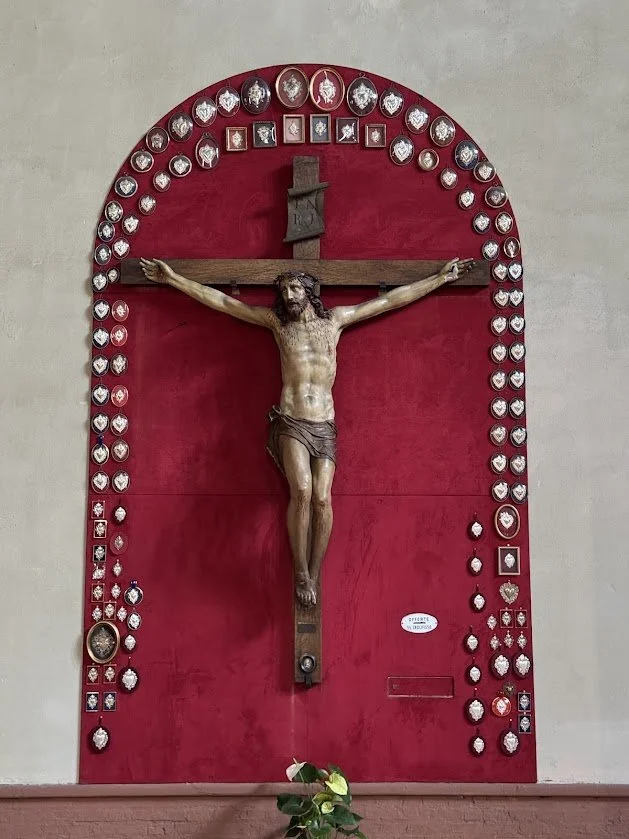
“While the world turns, the Cross stands firm.” It’s a quote we attribute to Saint Bruno, who lived
more than 900 years ago in Europe at the peak of Christendom. It has become a popular
phrase among Catholics, who understandably want to stand proud and defiant against a culture
that has seemingly forgotten our importance in the modern world. And while Saint Bruno likely
would agree, the quote goes back to his desire to create Christian encounters that were lacking
for his day.
Aside from the fact that the people of Bruno’s day understood the world to be flat– the revolving
world does not refer to a globe– the turning refers to the problem of Christendom where
Catholics would fight against one another for their brand of Catholicism, their influence over the
Church, and their national representatives of Catholicism to sit in Peter’s throne. Saint Bruno
was reflecting on a unity and virtue problem, not a tradition problem.
“While the world turns, the Cross stands firm.” It’s a quote we attribute to Saint Bruno, who lived
more than 900 years ago in Europe at the peak of Christendom. It has become a popular
phrase among Catholics, who understandably want to stand proud and defiant against a culture
that has seemingly forgotten our importance in the modern world. And while Saint Bruno likely
would agree, the quote goes back to his desire to create Christian encounters that were lacking
for his day.
Aside from the fact that the people of Bruno’s day understood the world to be flat– the revolving
world does not refer to a globe– the turning refers to the problem of Christendom where
Catholics would fight against one another for their brand of Catholicism, their influence over the
Church, and their national representatives of Catholicism to sit in Peter’s throne. Saint Bruno
was reflecting on a unity and virtue problem, not a tradition problem.
While serving as the administrator of the day-to-day activities in the Archdiocese of Reims,
Bruno found himself working for a bishop who was obsessed with protecting his own influence,
even attempting to ruin the lives and homes of those who opposed him. Later, he was an aide to
the Pope during a turbulent political era when the Church was setting itself up as a powerful
military and judicial authority that could compel the obedience of great kings. Without a doubt
his job must have complicated his prayer life. This was a golden age of Christendom. But Bruno
was aware that the culture of fighting for political relevance was not the type of tradition that the
holy Apostles handed down to us. Perhaps it was a silent protest or exhaustion, but Bruno was
not present when his boss gave a historic speech calling Catholics to arms for the crusades.
If Bruno could not find unity within Christendom, he would at least try to foster it through virtue.
The institution in those days offered people in power many perks. But he craved the type of
disarmed, and power disinterested culture that our Church had left behind centuries before.
How could a Church leader embedded in politics against his will come to live a dedicated life of
virtue during the Middle Ages? Retreat. And practice self-denial.
As Catholics, we now live in a world entirely unrelatable to the dominating political influence of
the Church that Saint Bruno knew. Bruno probably could have predicted this. He witnessed
many Catholic strongmen crowned, overthrown, and forgotten. The political, legal, and influence
machine of Christendom has largely dissipated. Today, there is no Catholic society – not in
Bruno’s sense. Not even the L.A. Religious Education Conference with 10,000+ attendees,
endless parade of bishops and priests, and a lot of incense remotely mimics the influence that
Bruno’s Church had.
The retreat from power that Bruno sought in order to be more authentically Christian was a
particular spiritual gift for his time. The way isolation is now imposed on people through cancel
culture and throwaway culture mimics this too, but twists Bruno’s gifts to make those spiritual
blessings fall flat. Society prefers Catholics be on their own, isolated away from the governing
affairs of the day. If Catholics are over here looking constantly inward at themselves, and society
is over there, then some sort of truce is able to be maintained.
Whereas Bruno brought spiritual riches to the Church for his day, today there are fewer visible
examples of the Church in our everyday life. The saint saw a direct link between prayer, justice,
and charity. Even for all of the political woes of the institutional machine, the Church was
something that you once could rely on. Today, the homeless go unnoticed, while the sick and
elderly remain isolated at home. Catholic schools are shuttering under the skyrocketing cost of
tuition forcing families out. There are simply fewer Catholics able or willing to do the hard work
of building the virtuous society.
Marred by sex abuse scandals with a worldwide figure of child victims likely exceeding a million
(as there were over 300,000 in France alone), it is no wonder that the world does not find us
credible in the way it used to. And so just like Bruno’s retreat, we too, must find a new way to
be authentic Christians for the world that we live in.
Today, the Christian experience that is lacking is one of sacramental “encounter.” One that
articulates in concrete ways how the Gospel and the Church’s teachings apply in their daily
lives. People need to trust that our traditions are passed on to help each one of us become all
that God made us for. It’s critical that people are not suspicious our traditions are an attempt to
control. Because that would not be authentic to the holy tradition passed down by the Apostles.
Namely that temptation to over-process and hyper-legalize our theology as it was in the days of
Christendom. We further know from the sex abuse crisis that without a healthy environment,
where people can call out their concerns without fear of being ostracized, that bad things will
continue to be concealed. The way to hand on the traditions of our faith, build credibility, and
sustain Christian communities relies on our openness and virtue.
I offer some reflections to help reimagine a world of virtue for the complicated culture we live in.
If you have ever heard the exaggerated phrase signaling disappointment, “don’t meet your
hero,” then you could probably guess that many –if not most– of our Catholic saints were living
some degree of let down in their lives. Post-conversion, and even until their last day. [A rather
silly example: the Sisters of the Sacred Heart were embarrassed that their founder Saint
Frances Cabrini broke into the Italian Senate unauthorized so she could petition elected officials
to help the poor. That story was hidden from all of her biographies.]
But we should stop washing the stains out their stories because, living in a complicated world,
these holy men and women are examples of authenticity and virtue despite their own
circumstances. That’s what we need today.
Canadian philosopher Charles Taylor grappled with this complexity problem. He noticed that the
world of today is less magical, less black and white. People have alternate explanations for why
natural disasters happen (aside from God’s wrath, which was the only logical conclusion of
Bruno’s day). This new age of science, democracy, and warfare through misinformation brings
us to the tail end of what Taylor would call the “Honor Society.”
In the old days of Christendom, it was important for Catholics to evaluate themselves within the
legal structures of Catholicism. How compliant were you? How attentive to the demands of the
Church were you? Were you respectful to people according to the rank in society you held? In
such a closed and legalistic society where the Church was also a world power, well, there
weren’t really any better ways to evaluate virtue.
This was, ok. It wasn’t great. But it was Ok. And perhaps Bruno recognized this for himself,
unfortunately a lot of bad actors in the Church have weaponized compliance against people.
From my own personal experiences, there were times in confession where I’ve been asked
extremely inappropriate questions but didn’t think twice because that same person regularly
preached about chastity – and for my own part it’s both natural to desire approval from your
priest and your church. A decade later, it turns out I wasn’t alone in my confusion over that
individual’s behavior.
Yet, even as I acknowledge that my experiences need to be reported –either because he was
actually exerting power over people in the name of virtue, or perhaps he just doesn’t have the
social ability to relate to others in normal ways– I’ve realized that even the A-team in
Catholicism have bad days.
How do we move past this sort of transactional virtue? The “honor society” as Charles Taylor
called it. The philosopher said that the way for faith to thrive in this environment is by building
the “dignity society” which is based on encounter. Truly getting to know somebody and their
dignity as God created them. More and more, priests in particular are facing pressures to
appear perfect, perhaps trying extra hard to make up for the actual bad guys of the past. But
perfection is not reality.
Instead, what if we understood holiness as a process of becoming all that God had made you to
be. We are on the journey together, and our priest is giving us the sacraments we need to make
it through. Instead of checking off a lengthy list of requirements to be holy, a different
understanding could help us on our lifelong journey of conversion. And that holiness is reached
through grace, but in communion with one another.
Why we say Unwanted and not Marginalized
First, thank you so much for your support of this project. Your subscription to the blog helps make the podcast possible and will also support the upcoming book with Paulist Press.
When I began putting this project together more than two years ago, a lot of people commented they were happy someone was working with Catholics on the margins. To a degree, they were correct, but it didn’t fully sit right with me.
Being "marginalized" is a wonky academic term. It’s almost impersonal. If someone says they are marginalized, they’re probably asking for a structural or political change. For example, if someone is handicapped, we can and should build a wheelchair ramp. But does that make them feel wanted?
First, thank you so much for your support of this project. Your subscription to the blog helps make the podcast possible and will also support the upcoming book with Paulist Press.
When I began putting this project together more than two years ago, a lot of people commented they were happy someone was working with Catholics on the margins. To a degree, they were correct, but it didn’t fully sit right with me.
Being "marginalized" is a wonky academic term. It’s almost impersonal. If someone says they are marginalized, they’re probably asking for a structural or political change. For example, if someone is handicapped, we can and should build a wheelchair ramp. But does that make them feel wanted?
There have also been long, thoughtful discussions what negative realities using the term “unwanted” to describe real people implies too. Some were worried it legitimizes attitudes by a few in parishes that want a smaller, more holy, elite crowd. And that’s precisely where we want to take this discussion. Not in a political sense, but to look at everything fresh with theological eyes.
"Theology for the Unwanted" (TFTU) is the name I eventually settled on because the main mission is to help people to set aside for a brief moment the political, structural, legal, and canonical lenses. Realistically, we can’t totally separate from them because we all live in the reality of a harshly politicized world. Though TFTU is about something different.
Through this project, I hope you can learn how to search deep within yourself and understand issues with the lens of a divine and loving God. It’s not easy and requires all of us to make mutual changes in our lives (that’s right: the Church and you making changes together). Thankfully, the more I researched our Church history, the more obvious it was that theology—in union with the Holy Father—has made all of us grow in Christ’s love over the centuries.
I don’t deny how immensely critical canon law is to our Church’s unity. It preserves and fosters community. But it is not the starting point for someone who wants to understand what it means to accept the eternal Christ and be transformed by him.
As Fr. Richard Rohr has said, we make God too small. We try to fit Him in our own human minds.
We all know and accept the phrase “God loves you,” but for whatever reason, our own biases and the things people around us have said cause an immense number of Catholics to doubt God’s personal love for them.
"Yes, God loves me, but…."
That phrase is the telltale sign of someone who feels unwanted. It’s a deeply theological intuition that at some level acknowledges the divine being of God sees your dignity exactly as you are created, but you have not quite caught up to that reality.
It got me thinking about whether there are differences in the term and what the consequences would be for theology. What does it mean to minister to someone who feels unwanted?
There is also a different, but often conflated, deep fear associated with feeling unneeded. Perhaps that’s why some senators and congressmen hold on to their seats until death is impending. Again, that doesn’t describe my own experiences in the Church either.
As a young kid, I always wanted to please our priests. No matter what faith, club, or group you belong to, it’s a very human desire. We all want to feel “wanted.”
Serving as an altar boy at the 6:15 AM morning Mass before school, Wednesday evenings too, and of course Sundays, I worked at a parish rectory on weekends and volunteered as much as I could. The approval of our parish leaders (including clergy) was a tangible sign that my relationship with God was on the right track.
However, the relationship with those around me in my parish didn’t stay so smooth and perfect once I hit my teen years. Being one of what we now understand to be a sizable number of Catholic teens and young adults grappling with sexual orientation, the message was clear: Fall in line, stay quiet, and be compliant.
Those who knew were happy to let me continue feeling wanted so long as my struggles were hidden from public view. Actually, even though it is probably done with good intentions, it is alarming how often I hear stories of “just don’t talk about it and everything will be fine.” We have a fear that being fully honest will cause the unity of the Church to come into question.
Among the many thought leaders we’ll discuss in future posts and podcasts will be Charles Taylor: The Politics of Recognition, The Ethics of Authenticity, and A Secular Age. Taylor lays out a roadmap for how to be fully Christian in a modern world. No matter how much Latin we bring back (which I like, by the way), we’ll never replicate the cultural contexts of a world that had no sense of why lightning strikes other than God was angry. There are alternate explanations now other than an angry divine being. But I fully believe—without throwing out any of the old—we can learn how to understand Catholic theology in a deeper and more meaningful way for the struggles that plague our Church.
The Catholic Church is beautiful. I love our traditions. And I want you to feel like you choose to be a healthy and fully participating member here. That’s why this is Theology for the Unwanted.