
Back to Tradition: The Theology of Fewer Pews
Let’s set the tone here. I love our beautiful intellectual tradition and want our churches to remain (or be rebuilt) as beautiful spaces that lift up our prayers to God. Yes, the Latin Mass is beautiful. But can it be replicated in the modern day and still capture all of the essential Eucharistic theology it once had?
We’ve gotten a little off track. Even becoming suspicious of those who want to see greater inclusion of the poor at church because it sounds political. But this is a theological blog.
On the podcast lately, we’ve been diving into the fundamental question of What does it mean to think like a theologian?
It’s a question of perspective.
· A doctor wants to know your vital signs (to understand your health)
· A lawyer wants to know your age and place (to know your rights and status)
· A theologian wants to know your relationship with God and his creation (others)
Theology, at its root, is relational. In Genesis 2, God says, “It is not good for the man to be alone.” Catholic theology is all about connection, covenant, and community. And for many centuries, the physical interior setup of parishes and social function of the Church reflected that priority. Before modernism—before the rise of democracies and individualism—the local parish was quite literally the community center.
It wasn’t just a place where the Mass was performed. It was a place where the Mass was lived. This vision is captured well in the spirit of the Middle Ages/Renaissance/Baroque era, where in most European cities the Catholic Church was the primary organizer of society.
The controversial sacramental theologian in Rome, Professor Andrea Grillo, has posted extensively about recapturing the original meaning of Aquinas and his Eucharistic theology. (Yes, he provokes a lot of conflict with those who love the Mass in Latin. But he makes very good points).
According to Grillo, the sacramental context for Aquinas was threefold. The form (bread and wine) and the truth (real physical presence of Christ) in the Eucharist were never separated from the virtue. The virtue was the unity of the people of God and communion with the Church.
Pews of Power or Pews of Presence?
I’m not interested in political discussions on this blog. Politics is virtually inescapable everywhere else you go. But I am interested in teaching Catholics how to toggle between a legal/political mind and a theological one – instead of forcefully mashing them together.
So what does a theologian think about this? Unfortunately, with the decline of the Church’s political power there has been a movement to restore a priest monarch-like figure at the altar with subjects kneeing loyally at the altar. The theologian has to resist the huge urge to see our Church as powerful and beautiful and instead focus on the Church as relational. Jesus himself was a personal real-life encounter 2,000 years ago. And he can remain that today if we bring him to the otherness of those in the pews.
The radical theological unity taught by the Eucharist was not a passive concept. It was not abstract. It was an active, spiritual marketplace where the wealthy and poor were bound together in spiritual dependence on one another.
They were present in the same space. Interacting with one another even as the outside world was highly structured and divided.
How? There were no pews.
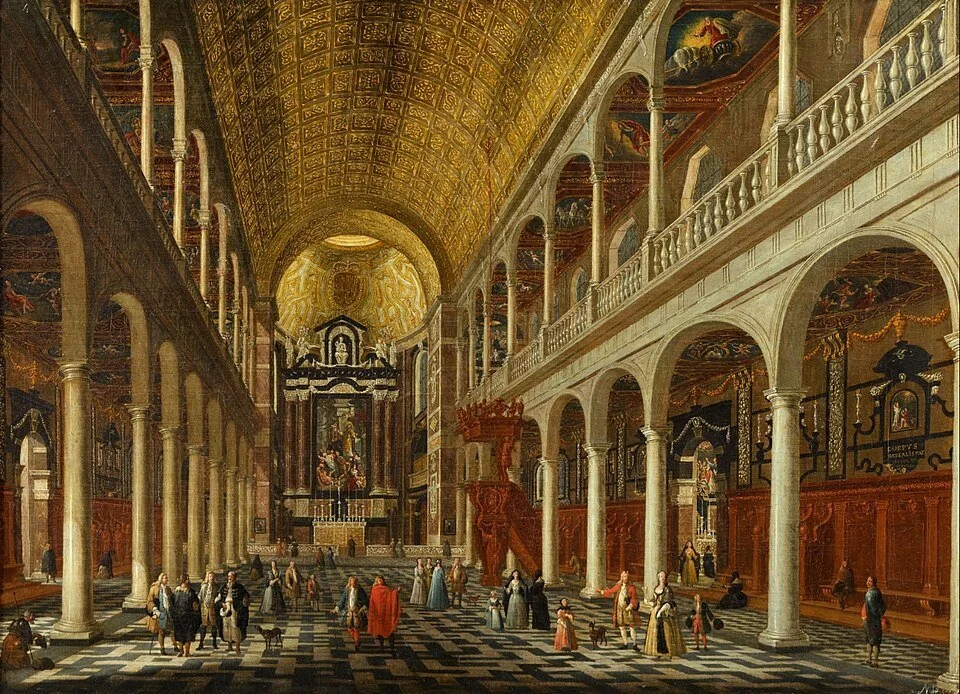
(pictured: painting of Saint Charles Borromeo parish in Antwerp, Belgium. Circa 1721 by Jacob Balthasar Peeters)
Beggars, the sick, and the poor congregated at the doors. Paintings of earlier eras even show this happening inside the church. Giving a small coin before or after Mass was expected. The rise of the Franciscans and Dominicans proved this to be an important way for Christians to live out their duties. We made our priests beggars.
During the sign of peace, people would kiss one another. And in later times, a “pax” board would be passed around the congregation so the whole people could kiss the same image.
There are many reports that at the end of Mass, the priest would bless the remaining consecrated bread and share it with the congregation. Yes. It seems there is evidence we were all snacking together as poor and rich Catholics alike after Mass. No need to leave the building. We are here as a community together.
The true tradition was not about subjects obeying a monarch figure but living in community together in a way that was not possible outside the church building.
To think like a theologian, we have to ask ourselves what is it about the Catholic relationship with God (and the unity with his people) that we are maintaining or losing with our current form of the sacred liturgy? Yes, the Latin Mass is beautiful. But can it be replicated in the modern day and still capture all of the essential eucharistic theology it once had?
Catholic theologian Dr. Thomas O’Loughlin has written about the need for the liturgy to once again reflect that synodality (walking together) that Catholic tradition tried to pass on. He has carefully critiqued the idea of separating people by status. (Note: in previous podcast episodes, we’ve talked about how Catholics tend to group themselves in church).
Dr. O’Loughlin says, “The solution is simple: create in the building—or any room capable of holding about 75 people—a level space free of pews/benches.”
He has also critiqued the idea of having a lofty display of washing the feet during the Holy Thursday Mass. “The command of Jesus is to all disciples: they must wash one another’s feet. They are not asked to mime Jesus’s activity, but to take his relationship of service among them to the paradigm of their relationship to one another.”
The Catholic Community of Sant’Egidio has a lengthier, drawn out version of this already put into practice in the 60 countries where they serve. They literally wash one another’s feet. Strange. Uncomfortable. But more attune to the theological instructions handed down. It’s probably not feasible worldwide, but it begs the question…are we replicating instructions or theology?
Theologians seek relationship with God. In the context of the Catholic Church, that relationship has always been reflected in our connections to one another. The original parish was defined by fewer pews and more contact. It was a deliberate blurring of the boundaries counter cultural to the world that existed outside.
Sources:
O'Loughlin, Thomas. "Synodality Needs to Express Itself in Liturgy." The Japan Mission Journal, vol. 76, no. 1, Spring 2022, pp. 27-38.
Grillo, Andrea. "Da Corpus Christi a Sanctissimum Sacramentum: la storia e la teologia sistematica." Come se non, 4 July 2025, www.cittadellaeditrice.com/munera/da-corpus-christi-a-sanctissimum-sacramentum-la-storia-e-la-teologia-sistematica/.
